Instagram Auto DM Statistics 2026: Open Rates, Response Rates, and Conversion Benchmarks
By ReacHook Team · 2026-07-15 · 9 min read
Most creators build their Instagram strategy around content. More posts, better captions, stronger hooks, optimized hashtags. What the data consistently shows is that the gap between creators who build audiences and creators who build income almost always comes down to what happens after the content—specifically, how fast they respond when someone raises their hand.
Instagram auto DM is the highest-performing direct-response channel available to creators and businesses in 2026. Not email. Not push notifications. Not ads. DM automation, when structured correctly, outperforms every other channel on open rate, response rate, and conversion rate simultaneously. But performance varies dramatically.
A well-designed comment-triggered DM sequence converts at 12–20%. A poorly designed broadcast DM barely hits 2%. The difference isn't the channel — it's the trigger, the message structure, and the offer alignment. This article covers the complete benchmark data for Instagram auto DM in 2026 — every rate, every variable that affects those rates, how the numbers compare to email, what the platform safety limits look like, and how Reachook's combination of DM automation and link-in-bio creates the conditions for these numbers to materialize consistently.

The Core Numbers: What Instagram Auto DM Delivers in 2026
Here's the full comparison between Instagram auto DM and email — the benchmark most marketers are used to measuring against.
| Metric | Instagram Auto DM | Email Marketing |
|---|---|---|
| Open rate (triggered) | 70–90% within first hour | 21–25% |
| Response/reply rate | 25–40% (triggered campaigns) | 2–3% (average) |
| Link click-through rate | 18–35% (high-intent) | 2–4% |
| Cold outreach response | 5–12% | 1–5% |
| Qualified lead conversion | 12–20% | 2–8% |
| Unqualified/broadcast conversion | 2–5% | 1–3% |
| Time to first open | Seconds to minutes | Hours to days |
These aren't aspirational numbers. They're what well-structured campaigns with the right trigger type, message length, and offer-audience alignment consistently produce.
The headline number 70-90% open rates within the first hour exists because DMs land in a private inbox that people check frequently throughout the day. Unlike email, where messages sit in a crowded folder and compete for attention, a DM notification creates an immediate expectation of personal communication. People open DMs because they expect something relevant to them, and triggered DMs are, by design, responding to something the person just did.
Email remains a valuable channel for longer nurture sequences, newsletters, and list ownership. But for immediate high-intent conversion, turning a raised hand into a sale auto-DM is the channel where the numbers live.
Open Rate Statistics by Trigger Type:
Not all auto DMs are created equal. Open rates vary significantly depending on how the DM was triggered — because the trigger determines how relevant and expected the message feels.
| Trigger Type | Open Rate | What Drives It |
|---|---|---|
| Comment-triggered | 85–92% | Person actively engaged with content, DM is direct response |
| Story reply-triggered | 78–95% | Person initiated contact, highest purchase intent |
| Follow-triggered | 40–55% | Timing varies, person may have forgotten the follow |
| Broadcast / non-triggered | 20–35% | No immediate context, feels like bulk messaging |
Comment-triggered DMs (85–92%) : perform at the top of the range because the sequence is natural: person comments, person receives a DM that directly delivers what was promised in the caption. The connection between the action and the response is immediate and obvious. There's no confusion about why the DM arrived.
Story reply-triggered DMs (78–95%) : are notable because the person initiated the conversation. When someone replies to your story, they chose to reach out to the DM. They receive in response feels expected, personal, and relevant. Story replies also carry the highest purchase intent of any organic trigger, which is why conversion rates from story reply flows tend to outperform comment flows even when open rates are similar.
Follow-triggered DMs (40–55%) : are the most variable because timing matters enormously. A DM sent within 90 seconds of a new follow catches the person while they're still on your profile. A DM sent hours later arrives without context the person has moved on and may not remember following. If you use follow triggers, speed is everything.
Broadcast and non-triggered DMs (20–35%) : are the lowest performers because they arrive without any behavioral context. The person didn't just do something that makes the DM feel like a natural response. This is functionally closer to email marketing than to triggered automation — treat it accordingly and don't measure it against comment-trigger benchmarks.
IMPORTANT
The key takeaway: trigger selection is the most important decision in your auto DM setup. Switching from a broadcast DM to a comment-triggered flow can increase open rates by 2–3x with the same message and the same offer.
Response Rate Statistics: What Actually Moves the Number:
Open rate tells you how many people see your DM. Response rate tells you how many people engage with it. The gap between the two is where most campaigns lose conversions.
These are the variables that have the clearest documented effect on response rates.
| Message Length | Response Rate |
|---|---|
| Under 50 words | 30–40% |
| 50–100 words | 18–25% |
| 100–150 words | 12–18% |
| Over 150 words | 8–15% |

This is the single most actionable finding in DM performance data. Shorter messages convert dramatically better, not slightly better, dramatically. The reason is contextual: a DM inbox is where people expect short, personal communication. A message that takes 45 seconds to read feels like a form letter, regardless of how warm the language is. Write your first DM response in 50 words. If you can't say what needs to be said in 50 words, you're trying to do too much in one message. Deliver the answer to their question, give them one link or one next step, and stop.
Personalization:
First-name personalization consistently generates 22% higher response rates than identical messages without it. This is pulled automatically from the person's Instagram profile; no manual work is required in any modern DM automation platform.
The effect compounds when combined with context-specific content. A DM that says "Hey Saash, here's the link you asked for" performs better than one that says "Hey Saash, thanks for your interest in our products." The first is specific to what they did. The second is generic despite the personalization.
Message Framing: Questions vs. Statements:
DMs that open with or include a direct question generate 3–4x higher response rates than DMs that make announcements.
"Here's your link: [link]" — statement, low response rate.
"Here's your link: [link]. "Quick question: Are you looking to use this for [use case A] or [use case B]?" question, significantly higher response rate.The question doesn't have to be complex. It just has to invite a reply. Replies extend the conversation window, deepen the engagement, and give you information that helps you qualify and convert.
Speed of Delivery:
Response to a trigger within 90 seconds delivers 40% higher response rates compared to delays of 10+ minutes. This tracks with broader conversion data buying intent peaks at the moment of action and decays fast.
When someone comments on your post and immediately receives a DM, the two events are mentally linked. When the DM arrives six minutes later, the connection is weaker — they've already scrolled to other content. This is the core reason auto-DM outperforms manual responses for high-volume comment triggers: it's not just the automation; it's the speed that automation makes possible at scale.
Follow-up Sequences:
Single-message campaigns leave a significant percentage of conversions on the table. Two-message campaigns — an initial DM and one follow-up at 24 hours — generate 35% more total responses than single-message campaigns.The follow-up works because people genuinely forget. They opened the DM, they intended to respond or click, and then life happened. A single well-timed follow-up reconnects with those people without feeling intrusive — particularly if it's framed as a check-in rather than a sales push.
"Hey saash — just checking if you had a chance to look at this! Happy to answer any questions if something came up."
That's it. No new pitch. No urgency language. Just a human-sounding check-in that recovers 15–25% of near-conversions.
Conversion Rate Statistics by Offer Type:->
Open rates and response rates are engagement metrics. Conversion rate is the revenue metric — what percentage of people who receive the DM actually take the action you want.
Conversion rates vary significantly by offer type, not just by message quality.
| Offer Type | Price Range | DM Conversion Rate | Notes |
|---|---|---|---|
| Free lead magnet (ebook, guide, template) | $0 | 40–65% | Highest conversion, lowest revenue per conversion |
| Digital products (presets, templates, courses) | $17–$97 | 12–25% | Best combination of conversion rate and revenue |
| Paid communities / memberships | $27–$97/month | 5–12% | Recurring value, lower initial conversion |
| Paid challenges | $47–$297 | 8–18% | Time-limited urgency helps |
| High-ticket programs / coaching | $1,000+ | 4–8% DM-to-call | DM books the call; call closes the sale |
Digital products at $17–$97 consistently deliver the best combination of conversion rate and revenue per DM sent. The price point clears the impulse-buy threshold; the person doesn't need to think hard about the decision while generating meaningful revenue per conversion. A 15% conversion rate on a $47 product from a 200-person comment-trigger campaign generates $1,410 in revenue from one post.
High-ticket offers ($1,000+) work differently. The DM doesn't close the sale — it books a discovery call or application. The 4–8% "conversion" here is call-booked rate, not purchase rate. A well-constructed high-ticket DM sequence qualifies the lead, generates interest, and routes them to a booking link. The close happens on the call.
Free lead magnets convert at the highest rate (40–65%) because there's no financial barrier. Every person who comments and receives a free resource is a "conversion" in this context. The strategic play is using a free lead magnet as the entry point to a paid sequence, delivering the free resource, and then introducing the paid product or community in a follow-up message 24 hours later.
The fundamental principle behind all of these numbers: qualified audiences convert 4–6x better than unqualified ones. A comment-triggered DM sent to people who engaged with a specific post about a specific problem delivers a very different audience than a follow-trigger DM sent to everyone who recently followed. The audience matching between trigger content and offer is what separates a 2% conversion rate from a 20% one.
| Metric | Header 2Auto DM (triggered) | Header 3 |
|---|---|---|
| Open rate | 70–90% | 21–25% |
| Click-through rate | 18–35% | 2–4% |
| Response / reply rate | 25–40% | 2–3% |
| Conversion (qualified) | 12–20% | 2–8% |
| Platform ownership | Platform-dependent | You own the list |
| Deliverability risk | Low (API-based) | Spam filter / domain reputation |
| Time to first open | Under 1 hour (90%+) | 6–24+ hours |
Email remains important. For list ownership, long-form nurture sequences, and communications that need to land regardless of platform changes, email is irreplaceable. But the comparative channel data in 2026 is clear about where the performance differences lie.
Where auto DM wins: speed, open rate, response rate, and conversion on high-intent, triggered campaigns. For any communication where immediacy and a personal feel matter—responding to a comment, delivering a promised resource, or following up on a purchase—DM wins by a wide margin.
Where email wins: list ownership (you keep the data regardless of platform changes), longer-form content, broadcast communications that don't have a trigger, and nurture sequences for leads who need weeks or months before buying.
The smart strategy uses both. DM automation captures the person at peak intent and drives the immediate conversion. Email capture inside the DM flow—asking for an email address as part of the sequence extends the relationship into a channel you own. Instagram can change its algorithm; your email list doesn't change with it.
Reachook's DM sequences support email capture natively—you can prompt followers for their email address in a DM, store it, and push it to your email list platform, converting Instagram engagement into owned audience data.
Platform Safety Limits: Sending at Scale Without Getting Flagged
Understanding Instagram's DM limits is the difference between running automation confidently and getting your account restricted.
| Account TypeSafe Daily DM LimitNotes | ||
| New accounts (under 6 months) | 20–50/day | Start low, warm up gradually |
| Established accounts (manual) | 100–150/day | Standard safe range |
| Official Meta API (approved tools) | 250–300/day | Higher limit with API access |
| Immediate high-volume jumping | Risk of restriction | 40–60% restriction risk if jumping without warm-up |
WARNING
The single most important factor in platform safety: whether you're using the official Meta Instagram Graph API or an unofficial tool. Unofficial automation tools — browser extensions that simulate human clicks, scrapers, bots — violate Instagram's Terms of Service and carry significant account risk regardless of volume. Instagram's detection systems have improved significantly in 2025–2026, and restrictions from unofficial tools are faster and more severe than in previous years.
Official API tools like Reachook operate within the infrastructure Meta built for business messaging. Rate limits apply, but they're significantly higher than manual limits, and the risk of account restriction from compliant API usage is minimal.
Warm-up protocol for new accounts:
If you're running DM automation on a newer account, start conservatively and increase gradually:
- Week 1–2: 15–25 DMs/day
- Week 3–4: 30–50 DMs/day
- Week 5–6: 60–80 DMs/day
- Week 7+: Full operating capacity
This mirrors natural account behavior and prevents triggering volume-based flags. Most established accounts (12+ months, regular posting history) can operate at full capacity from day one without a warm-up period.
The 24-hour messaging window:
After a user interacts with you on Instagram, comments on a post, replies to a Story, or sends a DM or taps a conversation starter, you have a 24-hour window to send promotional messages to them through the official API. Follow-up messages outside this window (for re-engagement campaigns to past contacts) must use non-promotional formats, or the person needs to re-trigger the window with a new interaction.
This is why email capture inside your DM flow matters: it creates a communication channel with no 24-hour window that you own and control.
A Real Campaign Breakdown: What These Numbers Look Like in Practice
Here's how a single comment-triggered campaign translates these benchmarks into real revenue.
The setup: A creator posts a Reel about a common problem in their niche. Caption ends with "Comment 'GUIDE' and I'll DM you the free guide + a resource I charge for separately." Reachook sends an instant DM to every commenter: the free guide link, a one-sentence description of the paid resource, and a soft invite.
Campaign results:
| Stage | Number | rate |
|---|---|---|
| Comments on post | 847 | --------- |
| DMs delivered | 847 | Row 2 Col 3100% |
| DMs opened | 698 | 82.4% open rate |
| Replies or link clicks | 412 | 59% response/engagement rate |
| Purchases at $197 | 64 | 15.5% conversion rate |
| Total revenue | $12,608 | --------- |

Time investment: 4 hours to set up the campaign (content creation + automation configuration). The 847 DMs and all follow-ups were sent automatically.
What made this work:
- The trigger was a specific comment keyword ("GUIDE"), not a generic follow trigger
- The initial DM was under 60 words answer delivered in the first sentence
- The free resource genuinely helped people; those who got value from it were primed to buy the paid product
- A 24-hour follow-up went to everyone who opened but didn't click: "Hey [name] — did you get a chance to look at the guide? Happy to answer anything if you have questions!"
- The follow-up recovered approximately 22% of near-conversions
The benchmark data in context: this campaign's 82.4% open rate and 15.5% conversion rate sit within normal ranges for a well-structured comment-triggered campaign in a specific niche. The "niche-specific" part is key — campaigns where the content, the trigger keyword, and the offer all align with a specific audience problem outperform generic campaigns by 3.1x on revenue.
Link-in-Bio + Auto DM: The Combination That Drives Consistent Results
Most auto DM guides focus entirely on what happens inside DM conversations. They miss the entry point: where does the traffic come from before the DM conversation starts?
Your link-in-bio is the permanent gateway between your Instagram profile and everything you offer. Every time someone visits your profile from a post, a Reel, a story mention, or a hashtag your bio is the first page they see. What you put in that bio, and where it leads, determines whether that profile visit converts into a conversation.
The full traffic flow:
Content → Profile visit → Bio link → Product/resource page → Intent
And the DM layer sits on top:
Content → Comment → Triggered DM → Conversion
These aren't two separate strategies; they're two complementary paths that serve different visitor behaviors.
Some followers click before they comment. They see your post, want to learn more, visit your profile, click your link-in-bio, and explore what you offer. Your bio link needs to route them to the right destination.
Some followers comment before they click. They engage with the post, trigger your DM automation, and get routed to the checkout or resource directly through the DM. They may never visit your bio.
Both paths matter. Optimizing only one loses a significant percentage of potential conversions.
What Reachook's link-in-bio covers:
Reachook includes a built-in link-in-bio feature alongside its DM automation, meaning your comment-triggered DMs, your story reply flows, and your bio link page all connect through one platform. Visitors who come through your bio see the same resources and products that your DM automation routes people to. The message is consistent. The destination is consistent. There's no scenario where someone from a DM lands somewhere different than someone from the bio.
What a high-converting link-in-bio looks like:
A link-in-bio page that converts profile visitors into leads or buyers isn't a list of every link you've ever shared. It's a focused page with a clear hierarchy:
- Primary CTA first (your most important offer, resource, or conversion goal right now)
- Secondary CTAs below (affiliate links, digital products, community, course)
- Optional email capture (newsletter, lead magnet)
- Social proof element (follower count, testimonials, reviews)
Reachook's link-in-bio supports custom pages, unlimited links, tracking pixels for retargeting, lead-capture forms, and full styling customization. For creators running DM automation campaigns, the link-in-bio serves as the always-on version of what the comment trigger delivers in response to specific posts.
The stat that ties this together: 73% of creators use link-in-bio tools to overcome Instagram's no-clickable-link-in-caption limitation. Creators who connect their link-in-bio directly to their DM automation flows using the same offers and resources in both see significantly higher overall conversion because every touchpoint is coherent.
| Metric | Below Benchmark | Likely Fix |
|---|---|---|
| Open rate | Below 60% | Switch trigger type — likely using broadcast or follow-trigger instead of comment/story reply |
| Response rate | Below 20% | Message is too long or too generic — cut to under 50 words, add a question, check personalization |
| Link click rate | Below 12% | Link is buried, CTA is unclear, or offer-audience mismatch — put the link in sentence 1 or 2 |
| Conversion rate | Below 5% | Audience isn't qualified, offer price doesn't match audience, or landing page has friction |
| Follow-up response | Below 10% | Follow-up arriving too early or too late, or phrased as a sales push rather than a check-in |
How to Audit Your Own Campaign Against These Benchmarks
If you're already running auto DM campaigns, these benchmarks give you a diagnostic framework. Here's how to troubleshoot each metric.
Diagnosing open rate problems:
If your open rate is below 60%, the trigger is almost always the issue. Broadcast DMs and follow-triggered DMs consistently open at lower rates than comment-triggered and story reply-triggered flows. The fix is to move your main campaigns to comment triggers use a keyword in your captions and catch the people who engage directly.
Diagnosing response rate problems:
If your open rate is strong but response rate is low (people are opening but not replying or clicking), the message is the issue. Three things to check: length (over 150 words → cut it in half), personalization (no first name → add it), and CTA clarity (multiple links or asks → pick one).
Diagnosing conversion problems:
If link click rate is strong but conversion is low, the problem is usually on the landing page — friction at checkout, price mismatch, unclear value proposition, or the link goes to a homepage rather than a specific product page. DM automation gets people to the door. The product page or checkout has to close them.
Diagnosing follow-up problems:
A follow-up that generates less than a 10% response usually means it's arriving outside the 24-hour window (losing the person's mental context), it's arriving within the first few hours (too soon, feels pushy), or it's phrased as a sales pitch ("Did you decide to buy yet?") rather than a genuine check-in.
What Reachook's Auto DM Setup Covers
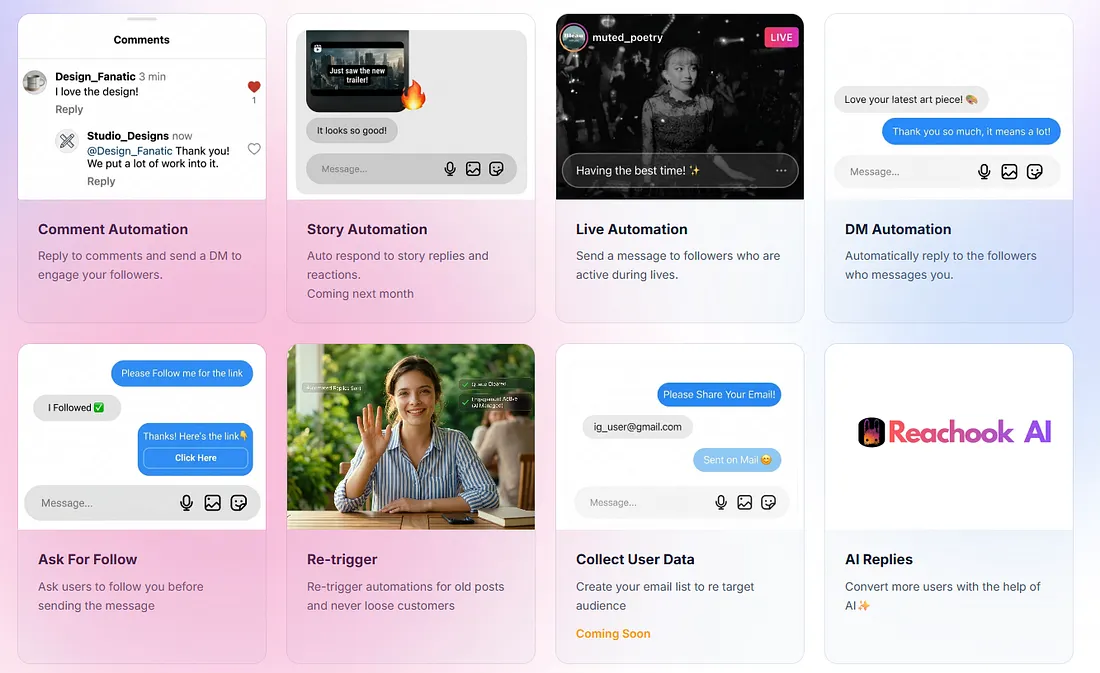
Reachook is built for exactly what these benchmarks require — comment-triggered DMs, story reply flows, follow-up sequences, first-name personalization, and link-in-bio management, all running on the official Meta Instagram Graph API.
What's included:
- Comment-to-DM automation — keyword-triggered instant DMs for any post or Reel
- Story reply triggers — automatic DM responses to story interactions
- Follow-up sequences — automated 24-hour follow-up to unopened or unclicked DMs
- First-name personalization — pulls automatically from the recipient's Instagram profile
- Conversation starters — always-on FAQ menu in your DM inbox for profile visitors
- Link-in-bio — custom page with unlimited links, lead capture forms, tracking pixels, and theme customization
- Multi-account support — manage up to 2 (Pro), 2 (Business), or 4 (Advanced) Instagram accounts from one dashboard
- Analytics — open rate, response rate, click rate, and conversion tracking per campaign
Everything runs on the official Meta API. No browser bots. No third-party scrapers. No account risk from ToS violations.
The connection between the link-in-bio and DM automation means you're not managing two separate systems—your bio link page and your comment triggers point to the same resources, the same offers, the same destinations. Profile visitors and DM recipients end up in the same funnel.
What is the average open rate for Instagram auto DMs in 2026?
70–90% within the first hour for triggered DMs (comment-triggered or story reply-triggered). Broadcast and follow-triggered DMs open at 20–55% depending on timing and context. The specific open rate you see depends heavily on your trigger type comment-triggered campaigns consistently outperform other trigger types.
How many DMs can I send per day without getting flagged?
Established accounts using the official Meta Instagram Graph API can safely send 250–300 DMs/day. Manual accounts without API access have a lower safe threshold of 100–150/day. New accounts should warm up starting at 20–50/day. Jumping immediately to high volume from any baseline carries a 40–60% restriction risk. Using an official API tool like Reachook is the safest way to operate at scale.
What's a good conversion rate for a digital product auto DM campaign?
12–25% for well-structured comment-triggered campaigns to qualified audiences. Below 5% usually signals audience mismatch, a message that's too long, or a landing page with friction. Above 25% typically means the product is very low-priced (impulse-buy territory) or the audience alignment is extremely strong.

What trigger type produces the best results?
Comment-triggered DMs (85–92% open rate) and story reply-triggered DMs (78–95% open rate) are the top performers. Follow-triggered DMs (40–55%) work but require near-instant delivery to perform well. Broadcast DMs (20–35%) are the lowest performers and should be treated as a distinct channel with different expectations.
Does auto DM work for high-ticket offers?
Yes, but the DM doesn't close the sale; it books the discovery call. For offers at $1,000 or above, the DM flow qualifies the lead, delivers social proof or a case study, and routes them to a booking link. The 4–8% DM-to-call-booked rate is healthy at this price point. The close rate on the call determines final revenue.
What's the difference between auto DM and a chatbot?
Auto DM with keyword triggers is simpler: one action → one response. No menu navigation, no branching decision tree. A person asks a specific question, they get a specific answer. Chatbots handle more complex structured conversations with multiple steps and branching logic. For most Instagram use cases — product questions, affiliate link delivery, lead magnet delivery, offer promotion — keyword-triggered auto DM converts better than chatbot flows because it removes friction.
Does message personalization actually matter, or is it marketing folklore?
It's documented, not folklore. First-name personalization consistently produces 22% higher response rates across multiple independent studies of Instagram DM performance. Context-specific personalization (mentioning what they commented or what triggered the DM) compounds this effect. The combination of first-name + context-match is the highest-performing message format in the data.
What should my link-in-bio page include for DM automation to work?
Your link-in-bio should mirror your primary DM automation destination — if your most active comment trigger sends people to a course, your bio link primary CTA should go to the same course. Consistency between your bio page and your DM flows means no matter how someone discovers your content, they land in the same funnel. Include one primary CTA, 2–4 secondary resource links, and an optional email capture form.
How does the 24-hour messaging window affect follow-up campaigns?
The 24-hour window opens each time a user interacts with you: comments, story reply, DM, conversation starter tap. Your automated follow-up must be sent within this window for promotional content. Re-engagement campaigns to contacts who haven't interacted recently need either a new trigger (asking them to comment on a new post) or must use non-promotional messaging. Email capture inside your DM flow is the best solution for contacts you want to nurture beyond the 24-hour window.
Is it worth running both link-in-bio and auto DM, or should I pick one?
Both — they serve different visitor behaviors. Comment-triggered DMs catch people who engage with specific content. Link-in-bio catches profile visitors who clicked through from anywhere. Optimizing only one loses a significant percentage of conversions. On Reachook, both run from the same platform, making it easy to keep them consistent and track performance across both channels.